
Most people who leave a big corporate job to start a company have a plan. Christof Gomez Manfeld had a problem: he'd spent seven years watching large organizations fail to make good decisions because their strategy lived in silos, their teams didn't know the business direction, and nobody had a system for connecting daily work to long-term outcomes. When he got fired from Bosch, he didn't pivot industries. He took everything he'd learned about systems thinking, machine learning, and organizational development, and built Solvee, the AI-powered accelerator that gives founders the strategic clarity that most companies spend millions trying to achieve. He joined the Start to Scale Podcast from southern Spain to share how he got there.
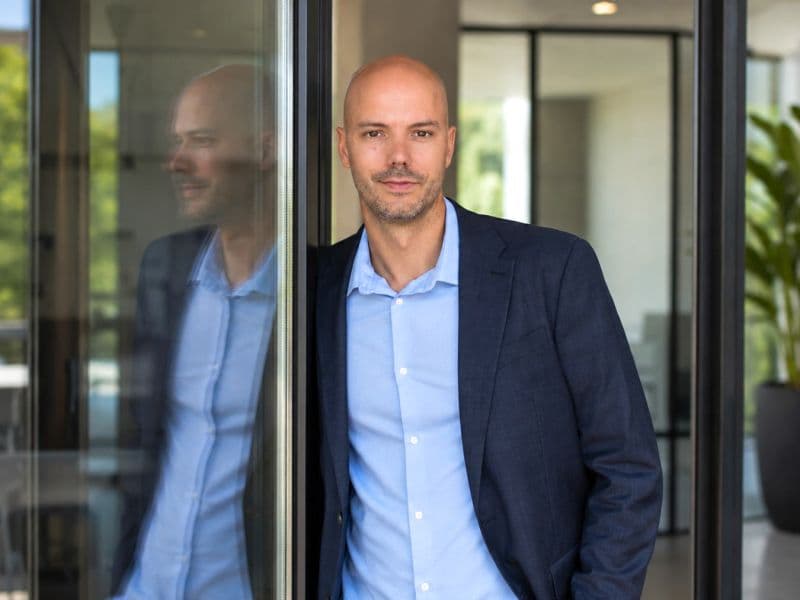
Christof Gomez Manfeld — founder of Solvee, Gildre member, and bilingual Spaniard-German building the AI accelerator for founders from southern Spain
Christof Gomez Manfeld is the founder of Solvee (solvee.app), an AI-powered personalized accelerator for founders, and a Gildre member based in southern Spain. After 18 years in Madrid, an electrical engineering degree in Germany, time in Houston and Pasadena, and seven years at Bosch in automotive machine learning and organizational development, he was let go, and built Solvee. He holds a European trademark on the Solvee name.
Between Two Cultures: Growing Up Spanish, Thinking German
Christof spent the first eighteen years of his life in Madrid. His mother is German, his father Spanish, but at home, they mixed both languages freely, switching mid-sentence whenever a word wasn't coming. It was a linguistic luxury that vanished the moment he moved to Germany to study at eighteen. Suddenly, he had to actually know the vocabulary. "I had to learn a lot of words that I didn't have to really memorize before."
The cultural displacement ran deeper than vocabulary. In Spain, he felt German. In Germany, he felt Spanish. After 24 years living in Germany, he returned to the south of Spain, a rural, traditional part of the country, and the friction showed up again in a new form. "I always felt a little bit like the outsider." It's a feeling he's made peace with. The double perspective, the ability to read both cultures from the inside, became one of his professional advantages: it made him curious about difference, comfortable with complexity, and unusually good at reading organizational dynamics from the outside in.
"I always felt the Spaniard in Germany and the German in Spain. I've never felt really at home anywhere, and that still is the case. But it opened a lot of doors."
Houston, JPL, and the Girlfriend at NASA Who Changed His Trajectory
At twenty, mid-way through his electrical engineering degree in Germany, Christof made a decision that he describes as rare even by the standards of his generation: he broke off his studies and followed his girlfriend to the United States. She had a job at NASA. First Houston, then Pasadena. She moved to the Jet Propulsion Laboratory at Caltech, and he went with her. He enrolled at Pasadena City College to keep studying.
The two years he spent in the US were formative and disorienting in equal measure. Houston and Pasadena are car cities, a jarring contrast for someone from walkable German student towns where the public transit was almost redundant because everywhere was within cycling distance. Crossing the road in Houston, he remembers, felt life-threatening. The cultural disconnection was real: "As a European, I had trouble finding context the way I used to have in Europe."
He came back to Germany, finished his degree in electrical engineering ("with a lot of pain," he says) and entered the job market with something most candidates didn't have: a history that made people curious. "I didn't have a very good degree, to be honest. But when they saw my history, they got curious. What type of person is this? And somehow I was likable enough that people would give me a job."
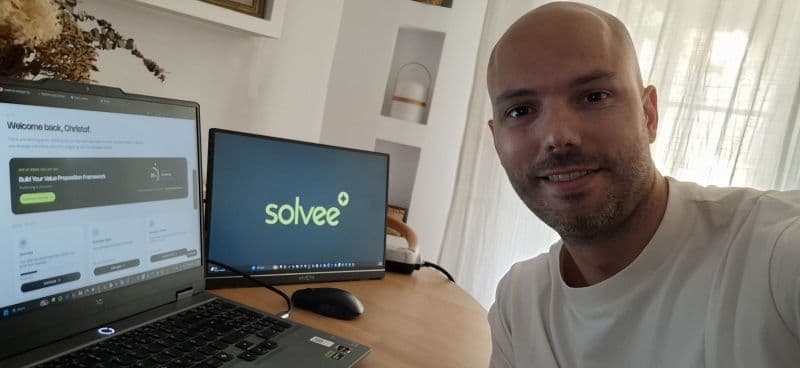
Christof Gomez Manfeld — seven years at Bosch led to the insight that built Solvee: founders need the same strategic clarity that big companies spend millions trying to create
Seven Years at Bosch, and the Machine Learning That Sparked an Idea
The job that came after his studies was in the automotive industry. Christof moved through Düsseldorf, Munich, and eventually Stuttgart, landing at Bosch, one of the world's largest engineering and technology companies, where he stayed for seven years. His role evolved: software engineer on paper, but in practice a project manager, then a process manager, then increasingly focused on organizational development and systems thinking.
The machine learning exposure came through his teams. One project that stayed with him: the front-end camera system Bosch was developing for vehicles. It used machine learning to recognize and react to inputs in real time. He wasn't building it himself at the technical level, but watching it work gave him a clear and early intuition that this technology was not a novelty. It was a platform. "I understood that this is a very interesting technology. I knew it was here to stay, and I was super motivated to learn about it and grow with it."
What stayed with him from Bosch wasn't the engineering. It was the organizational pathology he watched repeat across departments: strategy existed in silos. Marketing had a strategy. Engineering had a strategy. Finance had a strategy. None of them were connected. Teams worked hard on things that had nothing to do with the business's actual direction, and nobody had a system to surface that misalignment before it became expensive.
A Brother's Wine Bar and the Permission to Build
The entrepreneurial impulse had been dormant for years, buried under a career that was working well enough. It was his family that brought it back. His grandfather had built an electrical engineering company from scratch after World War II, and Christof grew up wanting to take it over. When his grandfather died, the company went sideways and was eventually acquired by an American firm before Christof was old enough to be part of it. The dream didn't disappear. It went underground.
Then his brother lost his job in Madrid and moved to Munich. Rather than look for another employer, he opened a Spanish wine bar. The location was small, not particularly visible, and the competition in Munich was real. He was successful anyway. "He had studied hotel management, he had a lot of experience in the industry, and he put all his energy and passion into this project." Watching someone who knew their craft, trusted it, and executed without a safety net made something click for Christof.
His parents did something similar after his father's early retirement: they built a small tourism business combining Spanish wines, theaters, and museums. Not a startup aiming for scale, just something built with passion, for the love of it. "It didn't have to make millions. Just to do something that you're passionate about and you enjoy doing." That became Christof's permission structure. When the opportunity came, he took it.
What Is Solvee? The AI Accelerator Built to Know Your Business
Solvee is not a chatbot. It is not a generic AI assistant. Christof is careful about this distinction, and for good reason. The problem with using ChatGPT or Claude for business strategy, he explains, is not that they're bad tools. It's that they're general-purpose tools. They give good answers. But those answers have no connection to your specific business, your specific stage, your specific assumptions, your specific gaps.
Solvee is built differently. It starts with a business assessment and moves through a structured curriculum of 43 steps, from initial idea through validation, business model design, go-to-market strategy, financial planning, scaling decisions, and eventually exit. At every step, it asks questions. The founder answers. The AI builds a proprietary knowledge base about that specific business. And once that base exists, everything changes: the advice Solvee gives is no longer generic. It is drawn from what the founder has told it, and only that.
"We want to make sure that the founder builds based on validation and not assumptions. There is a very, very big difference, and from my experience, people are very thankful for the clarity they get."
The hallucination problem that plagues most AI business tools is, in Solvee's architecture, structurally eliminated. If the AI only advises based on data the founder has provided, there is nothing to fabricate. "We try to reduce hallucinations to zero because we have all the data. There's no reason for the AI to hallucinate."
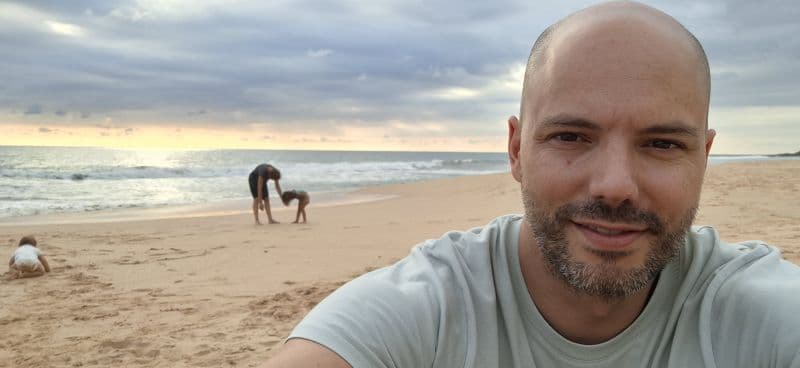
Solvee: the AI-powered personalized accelerator that guides founders from idea to scale and exit, built in southern Spain by Christof Gomez Manfeld
Systems Thinking: The Framework Behind the Product
The intellectual foundation of Solvee is systems thinking, a discipline Christof discovered through Donella Meadows' book and describes as one of the hardest and most rewarding frameworks he's encountered. Systems are not linear. They are full of feedback loops, time delays, and non-obvious interconnections that make them genuinely difficult to hold in one's head. "It doesn't come really natural to think in systems. They have so many interconnections that for us as humans it's very difficult to grasp how systems work."
When ChatGPT launched and Christof started interacting with it, he found something unexpected: he could use the AI to make systems thinking more accessible on a daily basis. The model already knew the theory. He could ask it questions, test applications, and practice applying the framework to real organizational problems far faster than any book or course had allowed. That experience of AI as an accelerator for a rigorous but hard-to-apply discipline is baked into Solvee's design.
Solvee is what happens when systems thinking and business strategy are packaged into a product that guides a founder through structured questions, captures the answers, and then applies frameworks precisely to the situation the founder has described. Not in theory. Not generally. To their specific business.
The Long Game: From Founder Operating System to Company-Wide Strategy
The current focus of Solvee is early-stage founders: the people with an idea, or running a company of two or three years, who have gaps in their business model they haven't named yet. Those founders often don't know what they don't know, and when Solvee's curriculum surfaces a gap, the response is usually gratitude. "From my experience, people are very thankful for the clarity they get."
But the roadmap extends further. As Solvee connects to financials, not just strategy, and it can flag problems the founder might have missed. Track performance against the strategic plan in real time. Alert when execution diverges from direction. Christof describes the end state as a founder's operating system: one place to see what needs to happen today, how the financials are performing, what the AI strategic advisor recommends, and how to prepare for the next funding round.
Further out: employees. The same dysfunction Christof watched at Bosch (teams working in isolation, strategies never converging) is the problem Solvee's organizational module will eventually address. When a company can give any employee real-time access to the business strategy, explain how their work connects to it, and flag when their work is drifting away from it, the misalignment that costs companies millions dissolves. "If you're working on things that have nothing to do with the business, you will very quickly notice."
Getting Fired Was the Best Thing That Happened to Him
After seven years at Bosch, Christof was let go. He took his family (wife, kids, all of them) and moved back to Spain. To a small town in the south. He's been building Solvee since. "Despite the uncertainty, it is an amazing ride. I get to meet people from Australia to the United States, sitting in Spain in a little town. It's an absolute blast."
His vision for Solvee has always been larger than revenue. The displacement happening right now (people losing jobs to AI, redundancies everywhere, workers without a path) is the problem Solvee is designed to meet. "For all the people getting fired right now, for whatever reason: there needs to be something they can build with their passion, their knowledge, their motivation to do something that actually has value in the world. They just need the structure."
"Give yourself the space. Believe in yourself that you can build something. If you're unhappy at your job, don't be miserable. I was fired, and I'm happy I was. Just go for it. It is an amazing ride."
Solvee is available now at solvee.app with a free version that Christof says delivers real value before any payment is required. The paid tier goes deeper. The feedback loop (what users love, what confuses them, where they drop off) is the most important metric right now, more than revenue. User experience workshops are running. Features are in the pipeline. And one of the biggest problems in the startup ecosystem (founders building on assumptions they mistake for validation) has finally found its product.
Frequently Asked Questions
Who is Christof Gomez Manfeld?
Christof Gomez Manfeld is the founder of Solvee (solvee.app), an AI-powered personalized accelerator for founders, and a Gildre member based in southern Spain. Born and raised in Madrid, he studied electrical engineering in Germany, lived briefly in Houston and Pasadena while his then-girlfriend worked at NASA's Jet Propulsion Laboratory, and spent seven years at Bosch in automotive project and organizational development before being let go and starting Solvee.
What is Solvee?
Solvee is an AI-powered personalized accelerator that guides founders from idea to scale and exit in 43 structured steps. Unlike generalist AI tools like ChatGPT or Claude, Solvee builds a deep, business-specific knowledge base about each founder's company by asking targeted questions and tracking their answers. This allows it to give highly contextual advice with near-zero hallucination because it is only advising based on data the founder has provided. It can also connect to financials, flag strategic gaps, and eventually serve as the operating system for an entire organization.
How is Solvee different from using ChatGPT or Claude for business advice?
Generalist AI tools like ChatGPT and Claude give broad answers that may not be applicable to a specific business. Solvee builds a proprietary knowledge base of each founder's business through a structured curriculum. Then advises based on that specific data rather than general training. This eliminates hallucination (there's nothing to fabricate when the AI only draws on what you've told it), ensures advice is contextual rather than generic, and creates continuity: the more you use Solvee, the more it understands your business and the better its advice becomes.
What are the 43 steps in Solvee?
Solvee's 43-step curriculum takes founders through the full journey from initial idea to scale and exit. It begins with a business assessment and moves through validation of assumptions, business model design, go-to-market strategy, financials, and scaling decisions. At each step, Solvee asks questions rather than providing prescriptive answers, tracking the founder's responses and building a complete operating picture of the business. The number of steps may evolve as the product develops.
What advice does Christof Gomez Manfeld give to early-stage founders?
Christof's core message: give yourself the space, and believe in yourself that you can build something. If you're unhappy at your job, don't be miserable. He was fired from Bosch and describes it as the best thing that happened to him. He also emphasizes building based on validation rather than assumptions: talking to potential customers and partners before committing to a product direction is something too many founders wait too long to do. And above all, do something you're passionate about, his brother's successful Spanish wine bar in Munich and his parents' tourism business are his evidence that passion-driven businesses, even small ones, can work.
Join the Community
Founders like Christof build alongside each other at Gildre.
Gildre is a global founder community for people who want real conversations, real accountability, and connections that hold up under pressure. Apply to join.
Apply to Gildre