
A Multi-Channel Outbound Sales Journey
Picture walking into Snowflake's sales floor in early 2024. The energy is electric, and for good reason – they've just announced nearly a billion dollars in quarterly revenue. But how did they get there?
The Multi-Channel Reality
83% of top-performing sales reps use a multi-channel approach.
Sales teams using LinkedIn plus email see 2X the engagement rate.
Video adoption in sales outreach has increased by 93% since 2019.
Think about how you browse Netflix, jump on WhatsApp, and check your email – all within minutes. That's exactly how your prospects move through their day. The best sales teams have figured out how to show up in all these places, naturally and meaningfully.
HubSpot's Growth
Take HubSpot's sales team, for instance. They discovered something pretty remarkable: when they combined video with their email outreach, their meeting bookings more than doubled. It was just meeting prospects where they were, in the way they preferred to engage.
Their sales team saw a 2.1x increase in meetings booked when using video + email vs. email alone.
LinkedIn InMail response rates averaged 3x higher than a cold email.
Sales sequences with 8-12 touches performed 40% better than those with fewer touchpoints.
Verified Channel Performance
From Gong's analysis of 1.5 million sales calls:
Tuesday at 10 AM shows the highest connection rates.
Follow-up emails sent within 24 hours of calls are 2x more likely to receive responses.
Sales reps who use video in prospecting see 26% more replies.
The Technology Dance
According to Gartner, companies are investing nearly $9,000 per sales rep in technology. It might be tempting to allocate the same resources across all channels, but isn't about simply spending on tools—it's about strategically organizing them for maximum impact.
The Rhythm of Modern Sales
Gong analyzed over 1.5 million sales calls (yes, really), and they found something interesting:
Tuesday at 10 AM is like the golden hour of sales, and it is accompanied by a key action: when sales reps follow up their calls with emails within 24 hours, their response rates doubled.
Stop bombarding prospects across every possible channel—some may not even fit your strategy. Instead, your approach should be thoughtful, strategic, and human.
Making It Work
For teams using monday.com, this all comes together in a practical way. Think of it as your command center – where every customer interaction, every follow-up, every win, and learning gets captured and turned into intelligence for your next move.
Pipeline Tracking
• Create custom boards for each channel.
• Set up automation for follow-ups.
• Track engagement metrics.
• Monitor team performance.
2. Integration Points
• Connect your CRM.
• Automate data entry.
• Track customer interactions.
• Measure channel effectiveness.
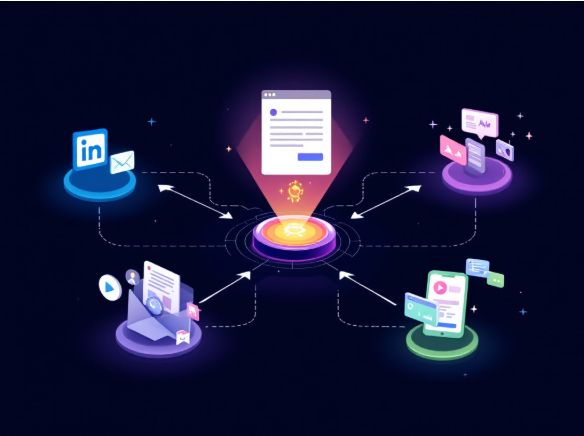
The Channel Content Matrix
Now that you know some valuable tools information, let us show you how to use them.
Email: Your Foundation. According to Gong's analysis, the most successful sales emails share three characteristics:
They're shorter than you think (under 300 words).
They include one clear insight or value proposition.
They end with a specific, time-bound call to action.
But here's where it gets interesting – the same message needs a different shape on each platform.
LinkedIn: Your Credibility Builder. The data shows that LinkedIn posts with these elements perform 2x better:
Real business insights (not just company news).
Personal experiences tied to business lessons.
Questions that spark genuine discussion.
Video: Your Personality Showcase Vidyard's research reveals that sales videos that convert share these traits:
Under 90 seconds for the first touches.
Personalized opening (showing you did your homework).
One clear, actionable message.
The Content Transformation Process
Here's how top performers take one core message and adapt it across channels:
Core Message Example: "Our platform reduced customer service response times by 45%"
On Email: "[Name], saw your recent post about customer response challenges. We helped [Similar Company] cut their response time by 45% last quarter. Quick question: what's your biggest bottleneck right now?"
On LinkedIn: "Just wrapped up a fascinating project where we tackled the response time challenge. Key learning: the solution wasn't more staff – it was smarter workflows. Here's what we discovered... [Details + Question to engage]."
As Video: "Hey [Name], noticed your team is growing fast. Wanted to share a quick case study about how we helped [Company] handle 2x the customer volume without adding headcount. Here's the interesting part..."
The Timing Dance
Gong's analysis of millions of sales interactions reveals a crucial pattern: content needs to flow in a natural sequence (Weeks 1 and 2 are the most critical for initial engagement):
Week 1:
Value-first content (industry insight or relevant case study).
Social proof (similar customer success story).
Direct, personalized outreach.
Week 2:
Problem-solution framework.
Specific use case aligned with the prospect's situation.
Clear next steps.
Weeks 3-4: According to Gong's data, if a prospect hasn't engaged by week 3, you need to shift your approach:
Re-engage with new insights or trigger events.
Share relevant industry news.
Reference competitor movements.
Provide additional case studies.
From this week onward, this becomes your "long-term nurture" phase:
Monthly check-ins.
Industry updates.
Relevant company announcements.
New case studies or success stories.
The key insight from sales engagement data is that after week 8, if there's been no engagement, it's better to:
Put the prospect into a long-term nurture campaign.
Look for new trigger events.
Wait for significant company changes.
Focus energy on new prospects.
In summary:
Start with your core value proposition.
Adapt it for each channel's unique strengths.
Test and measure engagement.
Refine based on real responses.
Scale what works.
The data tells us what works in 2024: multi-channel orchestration drives results. But here's what the spreadsheets won't show you: the best performers aren't just following playbooks – they're rewriting them. They understand that prospects aren't metrics in a dashboard; they're decision-makers navigating through digital noise.
Your move isn't to copy what worked yesterday. It's to test what will work tomorrow.
